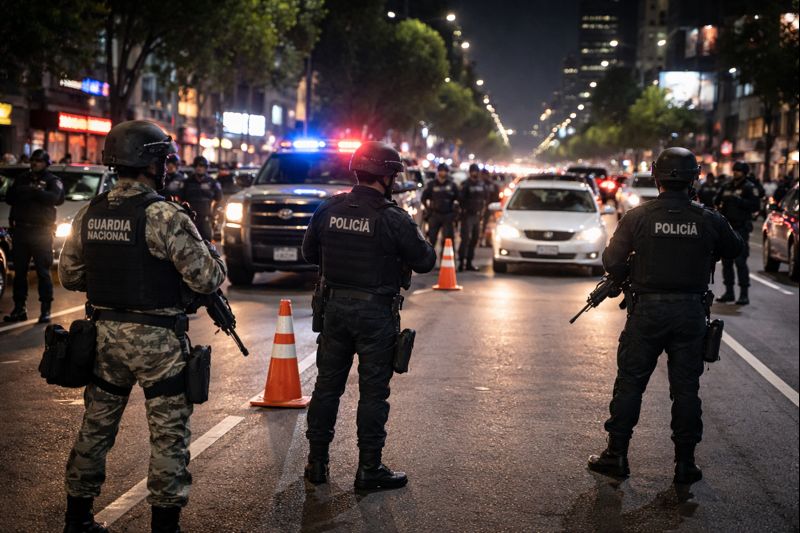
The same thing that happens anywhere else. You get shot.
This isn’t controversial in Mexico. It’s not debated. It’s not litigated in the court of public opinion before the body is cold. It’s understood.
Because Mexico—like Germany, like France, like Japan, like virtually every functioning state—recognizes a simple principle: if you use a vehicle as a weapon against law enforcement, you’ve escalated to lethal force, and lethal force will be returned.
No fog. No performance. Just consequence.
The Legal Framework
Under Mexican law, using a vehicle to assault a police officer triggers multiple severe charges:
Attempted Murder (Homicidio en Grado de Tentativa)
Using a multi-ton vehicle as a weapon demonstrates clear intent to kill. Under Articles 12 and 302 of the Federal Penal Code, this carries penalties of 15 to 40 years in prison.
Assault on a Public Servant (Ataque a la Autoridad)
Article 189 of the Federal Penal Code specifically addresses violence against law enforcement. Enhanced penalties apply when the attack involves a deadly weapon—which a vehicle legally qualifies as. You’re looking at 3 to 9 years, stacked on top of other charges.
Resisting Arrest (Resistencia de Particulares)
Even passive resistance carries penalties. Active, violent resistance? That’s Article 178: 6 months to 4 years. And that’s before we get to the vehicle part.
Mexico doesn’t treat this as a policy debate. It treats it as a crime. A serious one.
The Immediate Response
What happens in the moment when you drive at a Mexican police officer?
- The officer uses force to stop the threat. This typically means firearms. Mexican law enforcement—whether Federal Police, National Guard, or municipal officers—are authorized to use deadly force when faced with deadly force.
- You are arrested. Assuming you survive, you’re immediately detained. No catch-and-release. No citation with a court date. You’re in custody.
- You face pre-trial detention. Mexico’s legal system allows for prisión preventiva (pre-trial detention) for serious violent crimes. If you’ve just tried to kill a cop with your car, you’re not going home on bail.
- The case proceeds. Mexican courts don’t view this through an ideological lens. There’s no performance about “police violence” or “state overreach.” You used lethal force. The state responded. Case closed.
What This Looks Like in Practice
Unlike the United States, where every police shooting becomes a referendum on policing itself, Mexico treats officer-involved shootings as operational outcomes, not cultural moments.
When someone drives at an officer in Mexico City, Guadalajara, or Tijuana:
- The investigation focuses on whether the officer’s response was proportional to the threat
- The question is procedural, not philosophical: Was there an imminent deadly threat?
- If yes, the shooting is justified. Full stop.
- There are no viral hashtags. No sanctuary city mayors calling it murder. No federal officials accused of fascism for doing their jobs.
Because the premise isn’t in dispute: you cannot attempt to kill a police officer and expect the state to therapize your motivations.
The American Fog
Now contrast this with recent events in the United States.
When ICE Agent Jonathan Ross shot Renee Nicole Good after her vehicle moved toward him during an enforcement operation in Minneapolis, the response wasn’t legal clarity. It was fog.
- Sanctuary city officials called it murder
- Federal officials called it self-defense
- The media litigated intent, context, and the officer’s history
- Activists framed it as state violence against protesters
- The question became: Was she trying to flee or trying to kill?
In Mexico, that question would be procedural. In the U.S., it became cultural warfare.
Here’s the thing: Mexico doesn’t care about your motivations. If you drive at a cop, you’ve made a choice. The state responds to the choice, not the story behind it.
The U.S. treats every enforcement action as a narrative problem. Mexico treats it as an enforcement action.
Why This Matters
The question isn’t whether officers should be allowed to defend themselves. No serious person disputes that.
The question is: Why does the United States turn every act of enforcement into a moral audit of the state itself?
In Mexico, law enforcement operates with clarity:
- The laws are on the books
- The penalties are known
- The responses are predictable
- The fog is absent
In the United States, enforcement operates in ambiguity:
- Sanctuary policies undermine federal law
- Local officials grandstand against enforcement
- Every shooting becomes a test case for broader ideological battles
- Clarity is treated as cruelty
The Standard Is Universal
Here’s what’s true everywhere:
If you use a vehicle as a weapon against law enforcement, you will face lethal force in response.
This is true in:
- Mexico
- Germany
- Canada
- Japan
- France
- The United Kingdom
- Australia
It’s not controversial. It’s not debated. It’s understood.
The United States is the outlier—not because our enforcement is harsher, but because we’ve built a system that rewards ambiguity and punishes clarity.
The Real Question
The real question isn’t what happens when you assault a police officer with a vehicle in Mexico.
The real question is: Why do we pretend the answer should be different in the United States?
Mexico has clarity. Germany has clarity. France has clarity.
We have fog.
And in the fog, enforcement becomes performance, law becomes negotiation, and consequence becomes optional—but only for those willing to play the game.
Mexico doesn’t play the game. It enforces the law.
Maybe we should try that.